Sharp X68000
Cho Ren Sha Shoot 'em Up Without the X68000 we would have missed out on the best shooting game of all time, and that would've been a damn shame. This is a list of games for the Sharp X68000 computer system, organized alphabetically by name. See Lists of video games for related lists. Jan 17, 2014 Episode 97 - Let's take a look at the awesome, Japan-exclusive Sharp X68000 PC which played a hell of a lot of great games.

Contents. Operating system The X68k runs an called Human68k which was developed for Sharp. An -workalike, Human68k features -based commands very similar to those in; executable files have the extension.X.
Versions of the OS prior to 2.0 have command line output only for common utilities like 'format' and 'switch', while later versions included versions of these utilities. At least three major versions of the OS were released, with several updates in between. Other operating systems available include for X68030 and. Early models have a called 'VS' or 'Visual Shell'; later ones were originally packaged with. A third GUI called Ko-Windows exists with an interface similar to. These GUI shells can be booted from floppy disk or the system's hard drive.
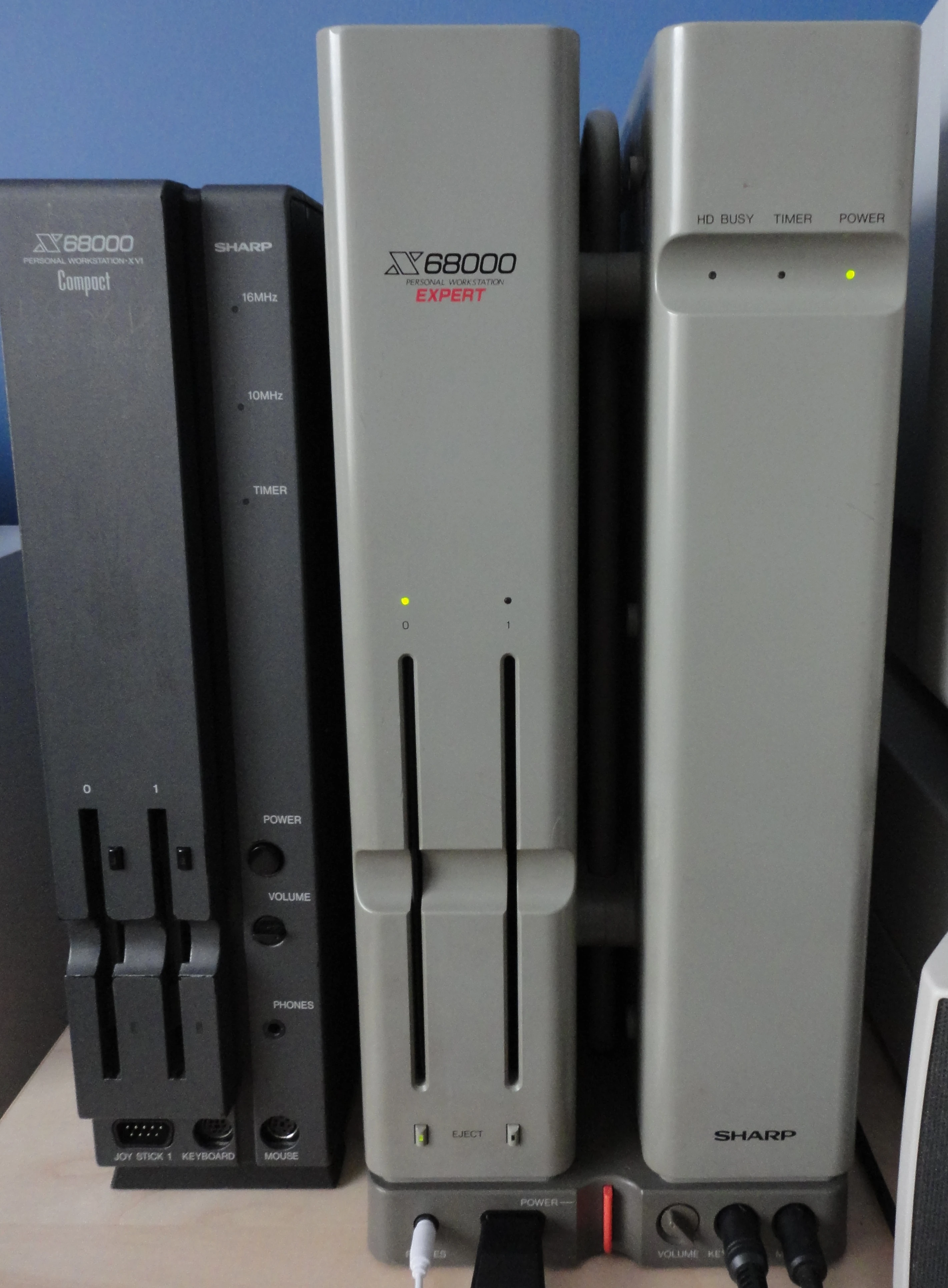
Most games also boot and run from floppy disk; some are hard disk installable and others require hard disk installation. Since the system's release, software such as Human68k, console, SX-Window C compiler suites, and ROMs have been released as and are freely available for download. Case design The X68000 features two soft-eject 5.25 in (133 mm) floppy drives, or in some of the compact models, two 3.5 in (89 mm) floppy drives, and a very distinct case design of two connected towers, divided by a retractable carrying handle. This system was also one of the first to feature a software-controlled power switch; pressing the switch would signal the system's software to save and shutdown, similar to the design of modern PCs. The screen would fade to black and sound would fade to silence before the system turned off. The system's keyboard has a mouse port built into either side.
The front of the computer has a headphone jack, volume control, joystick, keyboard and mouse ports. The top has a retractable carrying handle only on non-Compact models, a reset button, and a (NMI) button.

The rear has a variety of ports, including stereoscopic output for 3D goggles, FDD and HDD expansion ports, and I/O board expansion slots. Display The monitor supports 15/24 and 31 kHz with up to 65,535 colors and functions as a cable-ready television ( standard) with composite video input. It was an excellent monitor for playing compatible due to its analog RGB input and refresh timing. Disk I/O Early machines use the rare (SASI) for the hard disk interface; later versions adopted the industry-standard (SCSI). Per the hardware's capability, formatted SASI drives can be 10, 20 or 30 MB in size and can be logically partitioned as well. Does not support the standard of modern Windows systems, but it supports character filenames instead of the character filenames allowed in the. Human68K is case sensitive and allows lower case and encoded characters in filenames, both of which cause serious problems when a DOS system tries to read such a directory.
If a X68000 user restricts himself to use only filenames according to the 8.3 characters scheme of DOS, using only Latin upper case characters, then a disk written on the X68000 is fully compatible with other Japanese standard platforms like e.g. The, the and computers. The Japanese standard used by the X68000 is: 77 tracks, 2 heads, 8 sectors, 1024 bytes per sector, 360 rpm (1232 KiB). Expansion Many add-on cards were released for the system, including networking (Neptune-X), SCSI, memory upgrades, CPU enhancements (JUPITER-X 68040/060 accelerator), and I/O boards. The system has two joystick ports, both 9-pin male and supporting and controllers. Capcom produced a converter that was originally sold packaged with the X68000 version of Street Fighter II′ that allowed users to plug in a or controller into the system.
Zx Spectrum
The adapter was made specifically so that users could plug in the Capcom Power Stick Fighter controller into the system. Home arcade In terms of, the X68K was very similar to of the time, and served as the Capcom system development machine. It supports separate text RAM, graphic RAM and hardware sprites.
Sharp X68000 Roms
Sound is produced internally via Yamaha's then top-of-the-line FM synthesizer and a single channel OKI MSM6258V for. Due to this and other similarities, it played host to many in its day. Games made for this system include, Akumajo Dracula ( Castlevania in other regions, the X68000 version was ported to the as ), (which has a Windows port) and many others. Many games also supported the and MIDI modules for sound as well as mixed-mode internal/external output.